
A hand held laser cleaner uses focused laser energy to remove rust, paint, grease, oxide layers, and other surface contaminants without direct mechanical contact. Unlike abrasive or chemical cleaning methods, it directs a controlled laser beam onto the target area, allowing contaminants to be treated with precision. Because different materials absorb laser energy differently, suitable laser parameters can remove unwanted layers while limiting the thermal effect on the underlying surface. The cleaning result depends on factors such as laser power, scanning speed, pulse settings, and material properties.
1. How Does a Hand Held Laser Cleaner Work?
Laser Beam Is Directed at the Contaminated Surface
The process begins inside the laser source, where electrical energy is converted into a coherent beam. Industrial fiber-laser systems commonly operate around the 1064–1070 nm wavelength range. The beam travels through an optical fiber to the cleaning head, where lenses and a scanning mechanism guide it across the workpiece.
The operator holds the cleaning head at a suitable working distance and moves it over the contaminated area. Depending on the system, the scanner can create a line, oscillating pattern, or wider rectangular pattern. This movement distributes energy across the target instead of leaving the beam at one stationary point.
Contaminants Absorb Laser Energy
When the laser reaches the surface, the contaminant absorbs part of the optical energy and converts it into heat. Rapid heating can cause thermal expansion, evaporation, decomposition, melting, or fragmentation. The actual reaction depends on the contaminant, laser wavelength, power density, pulse characteristics, and thermal properties of the substrate.
In pulsed systems, individual pulses may last only nanoseconds. Short pulses can deliver high peak power over a very brief period, producing strong interaction with thin contamination layers while limiting the time available for heat to spread into the base material.
Contaminants Separate From the Base Material
As the contaminant absorbs sufficient energy, its structure can break down, and its bond with the underlying surface can weaken. Rust and oxide layers may crack or detach, while paint can decompose or fragment. Oil and grease can undergo rapid heating, evaporation, or thermal decomposition.
The objective is to provide enough energy to remove the unwanted layer while controlling the thermal effect on the substrate. This balance is particularly important when cleaning precision components or surfaces that must retain their original dimensions and properties.
Laser Scanning Controls the Cleaning Area
In a hand held laser cleaner, scanning determines how evenly energy reaches the target. Scan speed, scan width, overlap, and the number of passes affect the energy received by each location. The operator can move the cleaning head in a controlled pattern so that contaminated areas receive sufficient exposure without unnecessary repeated heating.
2. What Laser Parameters Affect How a Hand Held Laser Cleaner Works?
Laser Power
Laser power determines how much energy the laser can deliver to the surface within a given period, directly affecting cleaning speed and material removal efficiency. Lower power can be suitable for thin contamination or delicate surfaces, while higher power is generally more effective for thick rust, heavy coatings, or larger cleaning areas. However, higher power does not always mean better results. Excessive energy can increase heat accumulation and potentially affect the substrate, so the power level should be matched to the material, contaminant thickness, and desired cleaning effect.
Pulse Frequency and Pulse Duration
For pulsed lasers, frequency determines how many pulses are delivered per second, while pulse duration describes how long each pulse lasts. A setting of 50 kHz means 50,000 pulses per second. These parameters influence peak power, energy distribution, and thermal accumulation. They should therefore be adjusted as a combination rather than treated as independent controls.
Scanning Speed
Scanning speed controls the interaction time between the laser and each point on the surface. If the beam moves too quickly, the contaminant may receive insufficient energy. If it moves too slowly, unnecessary heat can accumulate. The appropriate speed depends on the substrate, contamination thickness, laser output, and cleaning objective.
Focus and Beam Size
The focal position affects energy density at the surface. A smaller focused spot concentrates energy into a limited area, while a larger spot covers more surface with lower energy density. Maintaining the correct working distance is therefore important for stable and consistent cleaning.
3. How Does a Hand Held Laser Cleaner Remove Different Contaminants?
Rust and Oxide Removal
Rust and oxide removal is one of the most common uses of a hand held laser cleaner. Surface rust is usually more loosely bonded than the underlying metal, allowing controlled laser treatment to break down and remove the oxidized layer while preserving the original surface structure. For light oxidation, a single scanning pass may be sufficient, while thicker or more uneven rust can require several passes.
The cleaning result depends strongly on the condition of the metal. Thin surface oxidation on steel can generally be treated differently from heavy corrosion with deep pits or scale. Operators may adjust the scanning speed, power, and number of passes according to the corrosion level, ensuring that stubborn areas receive additional treatment without unnecessarily affecting the surrounding metal.
Paint and Coating Removal
Paint and coatings can vary considerably in thickness, composition, and adhesion, so their removal behavior is different from that of rust. A hand held laser cleaner can be used to strip unwanted coatings from selected areas, making it possible to expose the underlying metal without mechanically grinding the entire surface. This is useful when only a specific coating layer needs to be removed.
For thick, multilayer, or strongly bonded coatings, the operator may gradually remove the material through multiple controlled passes rather than trying to eliminate the entire layer in one operation. Coating color, chemical composition, thickness, and the material underneath should all be considered when determining the appropriate settings. This approach provides better control when preparing a surface for repainting, welding, inspection, or further processing.
Oil, Grease, and Organic Contaminants
Oil and grease are generally softer and more fluid than rust or paint, so the main challenge is controlling how the contamination is treated without spreading residue across the surface. A hand held laser cleaner can target oil films and grease deposits on metal components, particularly where conventional wiping may leave behind a thin layer of contamination or require additional cleaning agents.
The required treatment can change significantly with contamination thickness. A thin oil film on a machined component may need only a light cleaning pass, whereas hardened or accumulated grease can require slower scanning or repeated treatment. Mixed contamination, such as grease combined with dust or metal particles, may also require parameter adjustments to achieve a consistent surface condition.
4. How to Choose the Right Hand Held Laser Cleaner?
Choosing the right hand held laser cleaner depends on the material, contaminant type, cleaning area, and required processing speed. Power is an important factor, but pulse settings, scanning speed, beam characteristics, and portability should also be considered. For light rust or thin coatings, a lower-power system may be sufficient, while heavier contamination may require higher output.
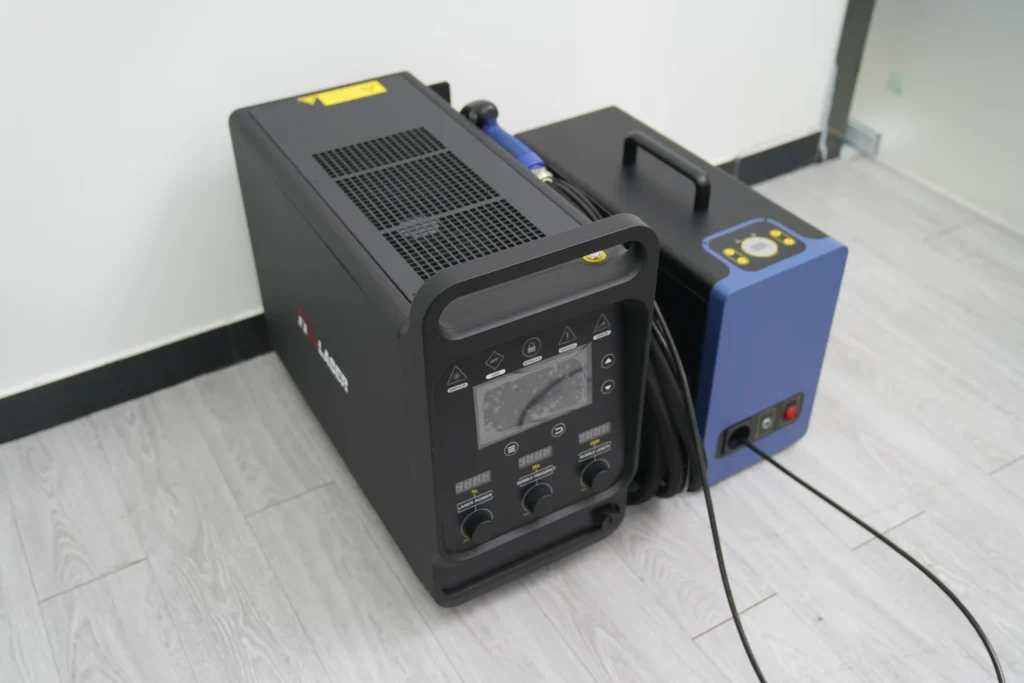
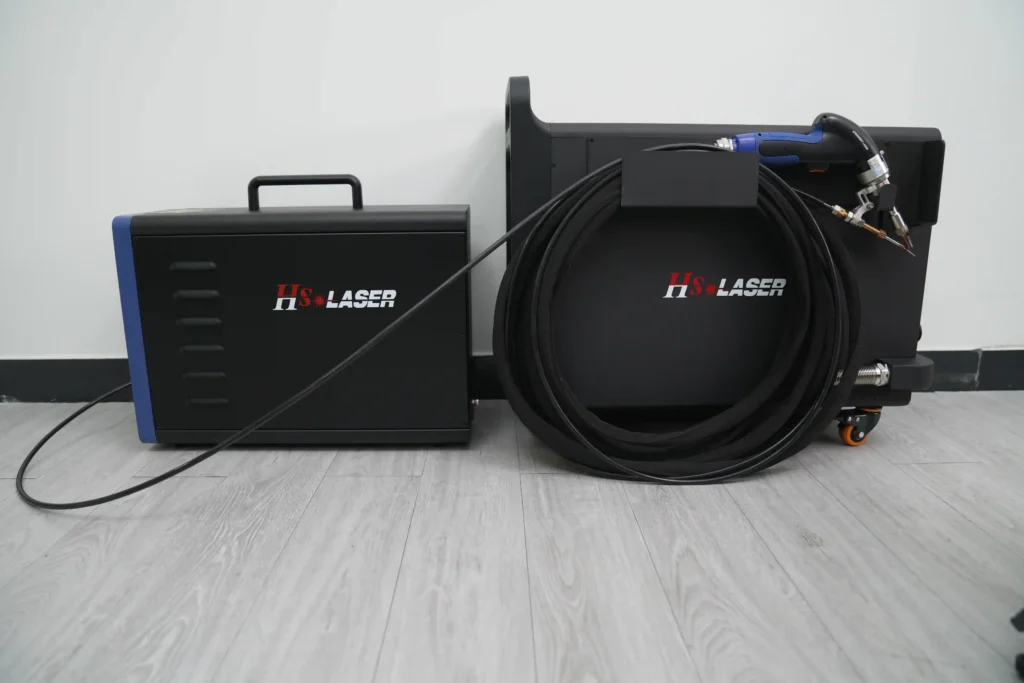
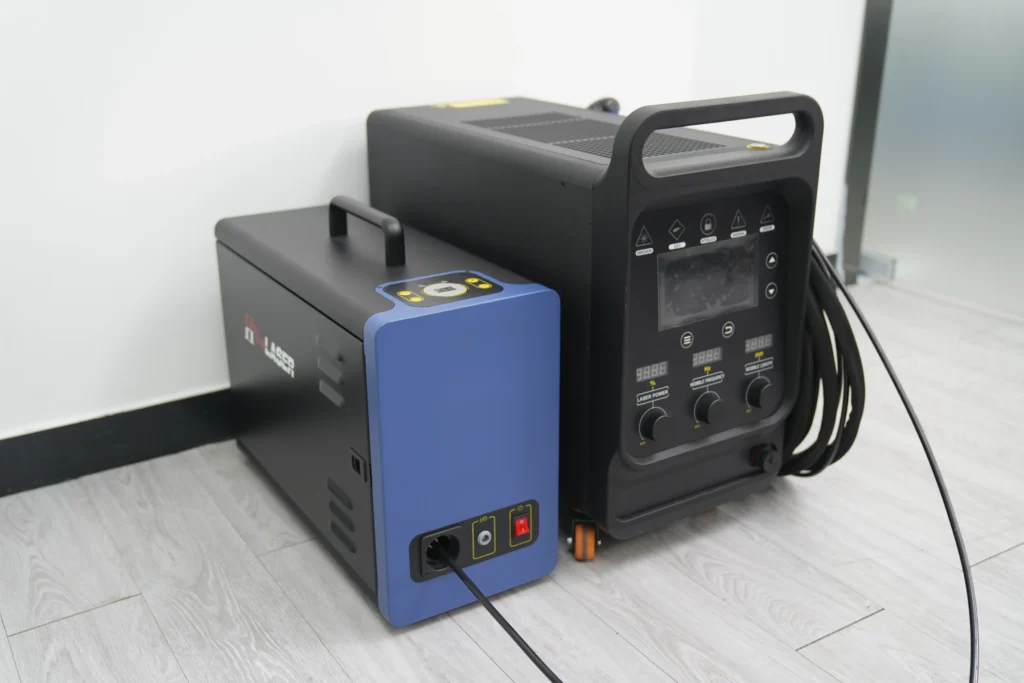
For manufacturers and maintenance teams that need flexible cleaning for rust, paint, oil, and oxide layers, the HS LASER 200W–300W Pulse Fiber Laser Cleaning Machine can be a practical choice. Its 200W–300W pulsed laser system provides controlled energy for different surface-cleaning tasks, while the portable suitcase-style design makes it convenient for on-site maintenance and flexible industrial applications. Before use, testing the equipment on representative materials can help determine the most suitable settings and cleaning results.
5. Conclusion
A hand held laser cleaner removes contaminants by applying controlled laser energy to the surface. Factors such as power, wavelength, pulse settings, scanning speed, and focus affect the cleaning result. For manufacturers, testing the target material and contamination is important because different surfaces require different laser settings. HS LASER provides laser cleaning equipment and solutions for various industrial surface-treatment needs. Contact us for suitable technical guidance and equipment recommendations.